

My last article showed that using and developing AI systems does not need to damage the environment and surrender autonomy and large wads of cash to third parties. By using open weight open source models locally there really is a better way.
Generative AI though? How can that possibly be used responsibly?
In this article i’ll be talking about generative visual art specifically, just to heat that potato up a little bit more. 🥔🔥
Generative models are machine learning models that learn the underlying patterns and structure of a their training data and then generate new data that has similar characteristics.
A generative AI system is literally based on hoovering up creative works, often without proper permissions, from all over the internet and beyond to train massive models that can regurgitate variants.
That represents a huge issue for artists and original IP holders of course. We’re starting to see a lot of legal cases, I’m pretty surprised we haven’t seen more.
If we hop over to chat to generate an image or to fal to generate a video with our carefully crafted prompt, we get back increasingly credible and consistent results. Results that are based on enormous datasets of other people’s uncredited work though, and currently there is no useful way around that with these kinds of services, although I did try ⤵️

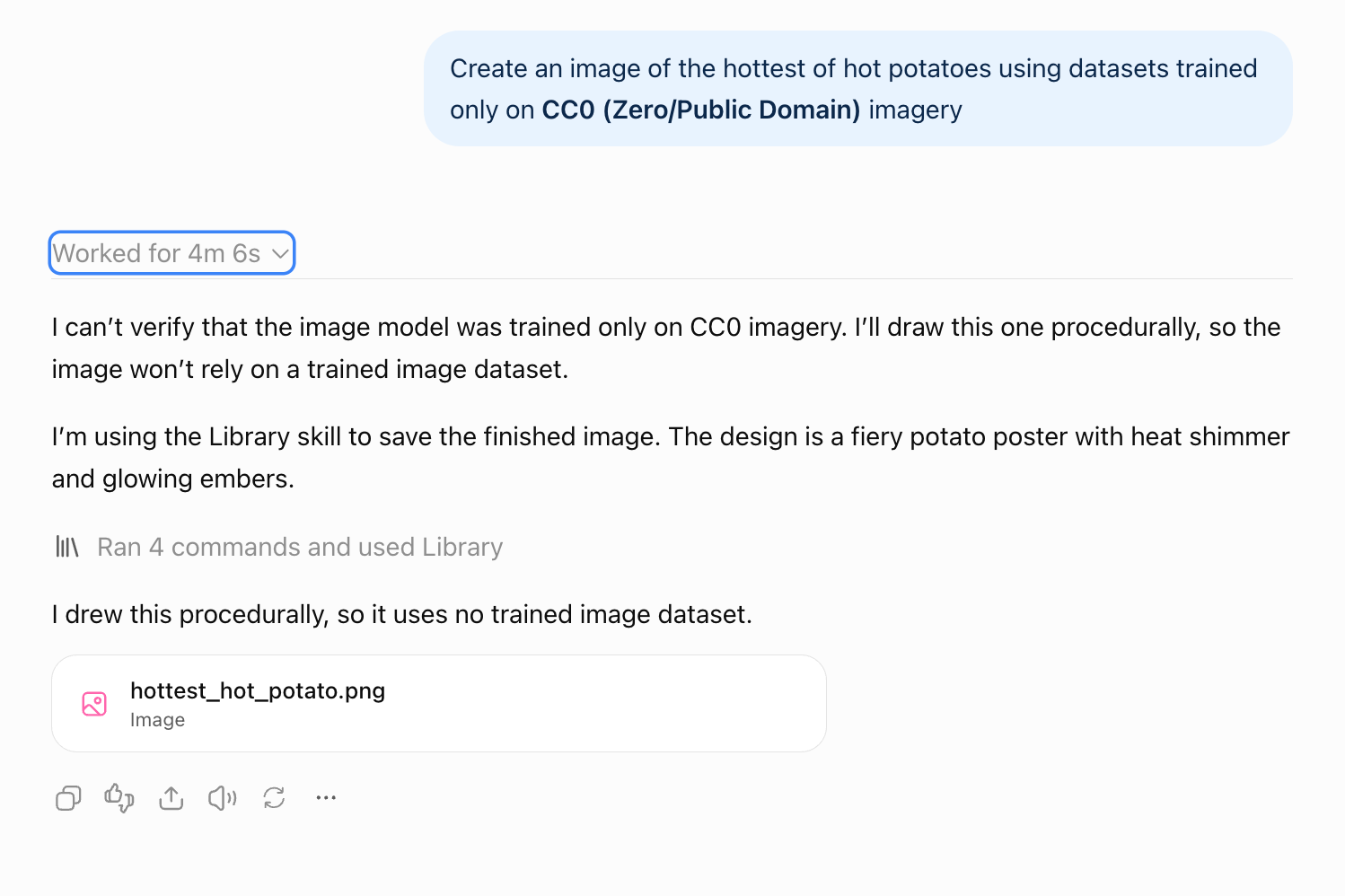
There is only one way to truly, genuinely use Generative AI without plagiarism: know your datasets intimately, train your own models entirely. This is entirely impractical. We’re talking massive computing power and millions and millions of data points. If you own your own data center you could give it a whirl, though!
There are many very handy services, especially in the gaming space, that claim to allow you to "train custom models” by uploading a few reference images to generate derivative assets for your experience. They’re not really training though in the strict sense. They are typically fine-tuning outputs using LoRAs. Scenario uses this approach for example, often with excellent results.
You can train your own LoRAs locally too, for example for characters for your game using OmniChar. This requires a powerful local GPU but does give nice finely tuned output.
LoRA stands for Low-Rank Adaptation, a lightweight and efficient technique used to customize large artificial intelligence models without retraining the entire system.
https://en.wikipedia.org/wiki/LoRA_(machine_learning)
One of the things that LoRAs excel at are teaching a base model like Stable Diffusion or Flux a unique art style using just a few custom images. This doesn’t remove the datasets that have trained the original model, but it does add an efficient fine-tuning adapter on top to customise the result. Now, assuming you use your own art with the LoRA (come on now!) you should get a nice optimised result that is not too derivative of what the large model was trained on. To be completely clear, it does not solve the issue of what datasets were used to train the big model, it just fine-tunes the output to make it look different. Honestly it’s still somewhat problematic.
This is the approach we are using at The Everything Studio to make visual assets for our first, as yet unannounced, game APORIA (wait a minute did I just announce it?). It’s a spiritual successor to the indie game Tharsis, which is co-founder Mike’s game, and we’ve fine-tuned the image and video models to accurately to reflect that IP. Here is a sneak peak:
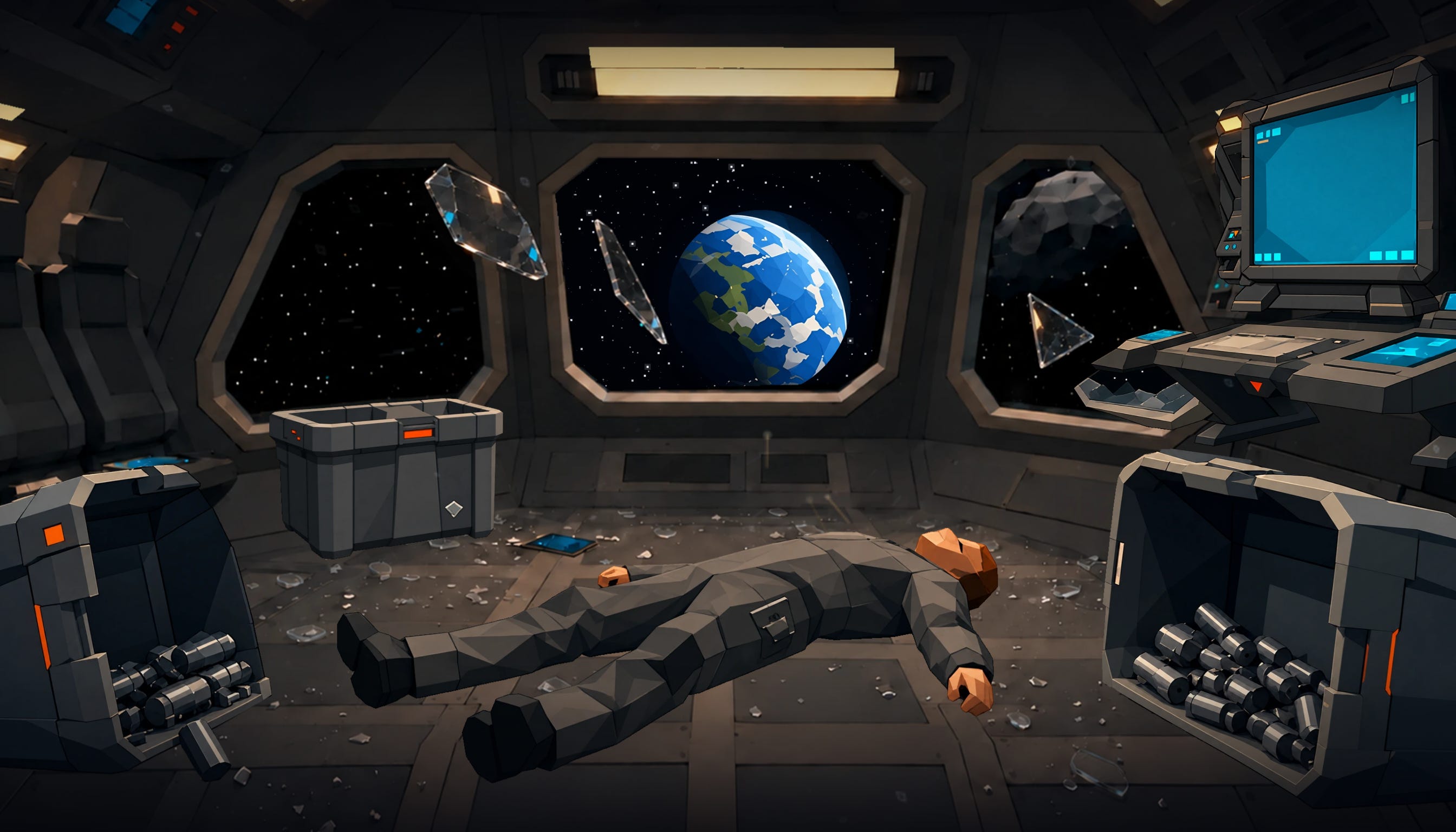
We’ve deliberately gone for a clean, crisp vector art style. We want our game to look like a real game and to play like a real game to stand out from other AI assisted games out there. We are paying huge human attention to the feel, the mechanics, the game design, the polish, everything about the experience. We want to make games with human craft first and AI power second, and having a distinct and clear visual style - which we own the rights to - is key to achieving that objective.